PTE Core 2026 Score Contribution Table
Understand the PTE Core 2026 score contribution table, official skill mappings, question ranges, and PTE Ultra study priority for every task type.
PTEUltra.com
PTE Core Score Guide - 2026
PTE Core 2026: Official Score Contribution Table and Study Priority
A clear guide to which PTE Core tasks affect Speaking, Writing, Reading and Listening, with question ranges and PTE Ultra priority notes for smarter preparation.
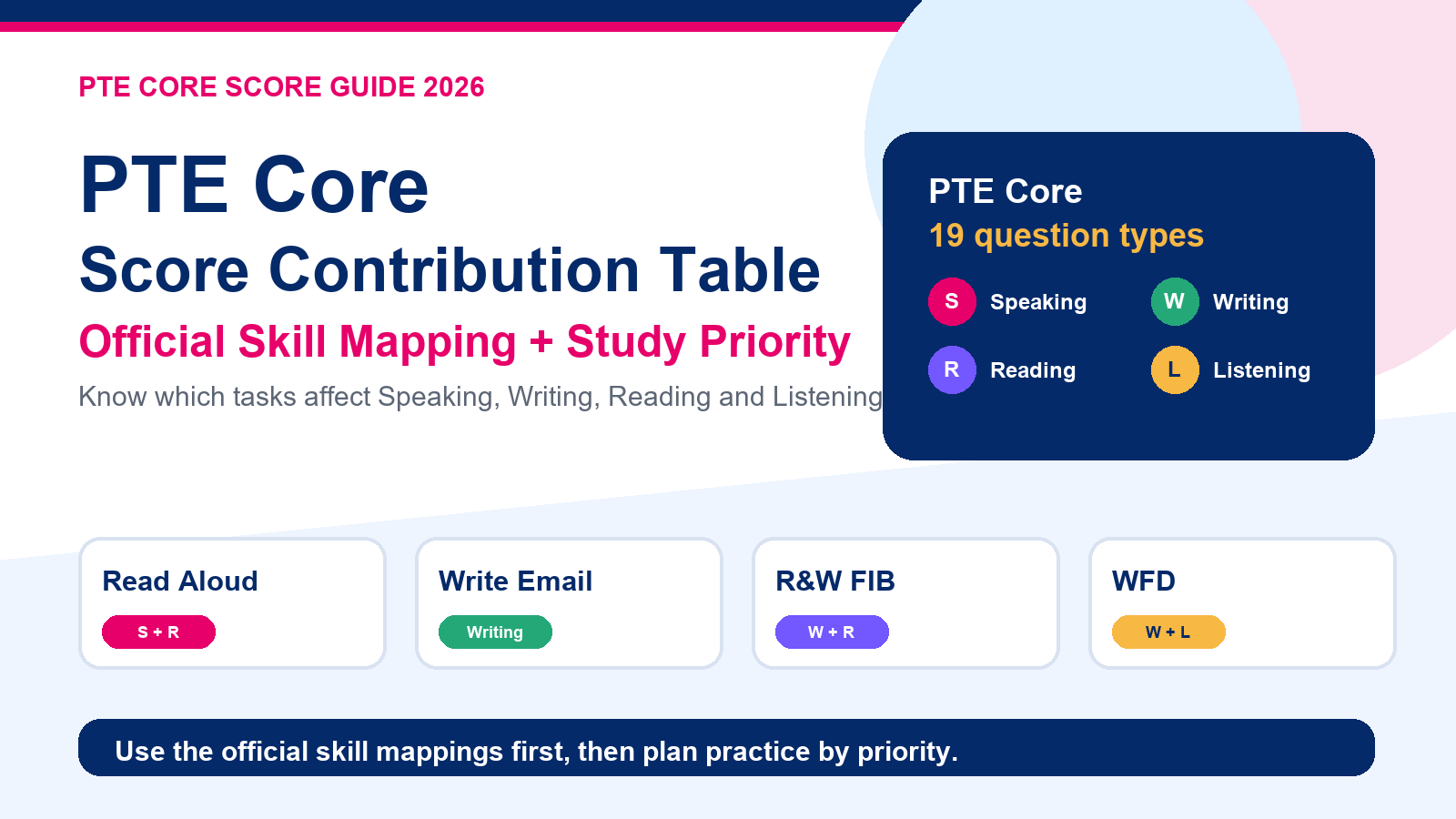
PTE Core scoring is easier when you know the skill mapping. Some tasks affect one skill only, while integrated tasks can support two skills at the same time.
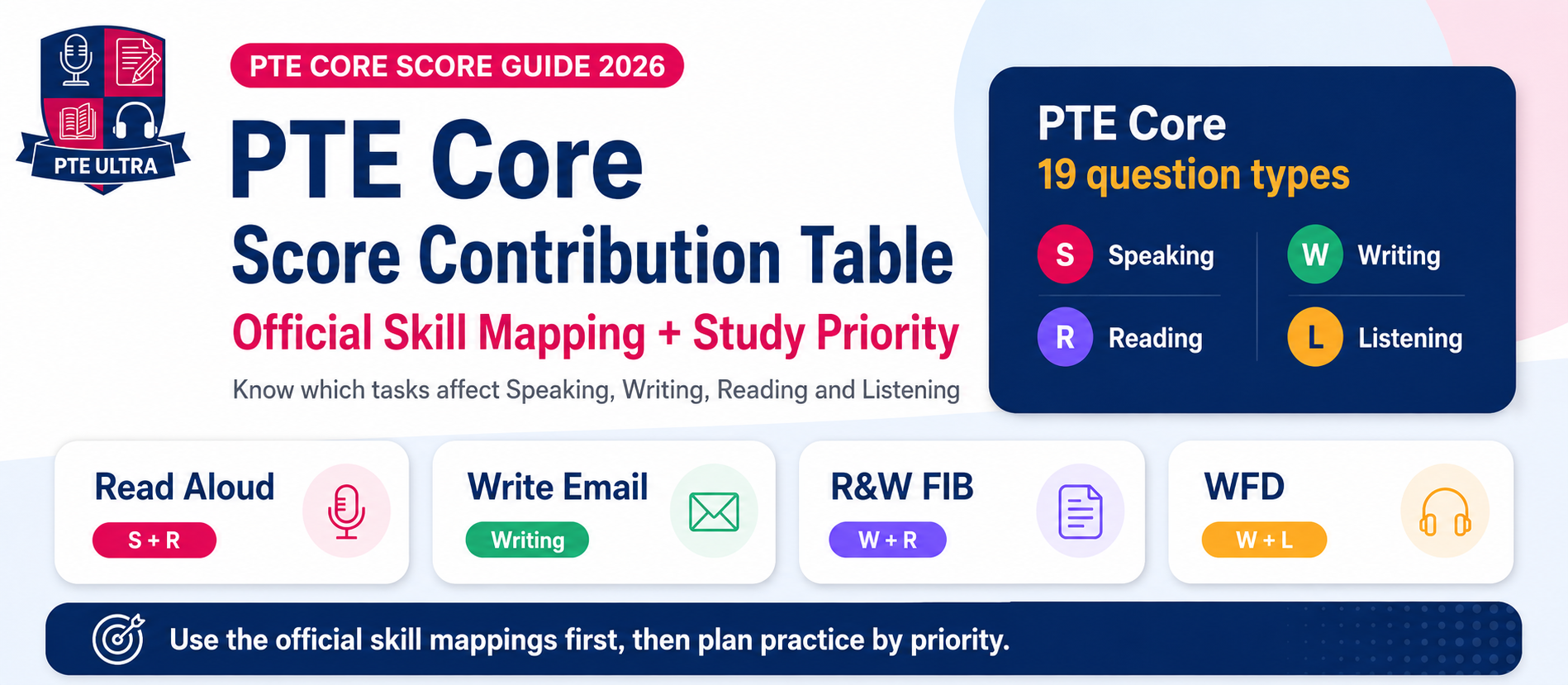
PTE Core has 19 question types across Speaking & Writing, Reading and Listening. If you are preparing for Canada PR or work-focused English goals, understanding score contribution is important because not every task affects the same skill score.
The skill columns below follow Pearson PTE Core scoring guidance and test-format pages. The priority column is a PTE Ultra study-planning estimate to help you decide where to spend more practice time.
Quick PTE Core Structure
How to Read the Table
A tick means that task contributes to that communicative skill. A dash means that skill is not the main scoring area for that task. Some tasks are integrated, which means one response can support more than one score.
PTE Core 2026 Score Contribution Table
Use this table to plan your preparation. For example, if your Writing score is weak, you should not practise Write Email only; you should also practise tasks such as Reading & Writing: Fill in the Blanks, Summarize Spoken Text, Listening Fill in the Blanks and Write from Dictation.
| Module | Question Type | Speaking | Writing | Reading | Listening | Questions | Priority |
|---|---|---|---|---|---|---|---|
| Speaking | Read Aloud | Yes | - | Yes | - | 6-7 | Very High |
| Speaking | Repeat Sentence | Yes | - | - | Yes | 10-12 | Very High |
| Speaking | Describe Image | Yes | - | - | - | 3-4 | High |
| Speaking | Respond to a Situation | Yes | - | - | - | 2-4 | High |
| Speaking | Answer Short Question | Yes | - | - | Yes | 5-6 | Low |
| Writing | Summarize Written Text | - | Yes | Yes | - | 1-2 | High |
| Writing | Write Email | - | Yes | - | - | 2-3 | Very High |
| Reading | Reading & Writing: Fill in the Blanks | - | Yes | Yes | - | 5-6 | Very High |
| Reading | Multiple Choice - Multiple Answers | - | - | Yes | - | 1-2 | Low |
| Reading | Reorder Paragraph | - | - | Yes | - | 2-3 | Medium |
| Reading | Reading Fill in the Blanks | - | - | Yes | - | 4-5 | High |
| Reading | Multiple Choice - Single Answer | - | - | Yes | - | 1-2 | Low |
| Listening | Summarize Spoken Text | - | Yes | - | Yes | 1-2 | High |
| Listening | Multiple Choice - Multiple Answers | - | - | - | Yes | 1-2 | Low |
| Listening | Listening Fill in the Blanks | - | Yes | - | Yes | 2-3 | High |
| Listening | Multiple Choice - Single Answer | - | - | - | Yes | 1-2 | Low |
| Listening | Select Missing Word | - | - | - | Yes | 1-2 | Low |
| Listening | Highlight Incorrect Words | - | - | Yes | Yes | 1-2 | High |
| Listening | Write from Dictation | - | Yes | - | Yes | 3-4 | Very High |
Highest Priority Tasks for PTE Core
If you have limited time, start with the tasks that affect more than one skill or carry high practical scoring value. These tasks can improve your score faster because one practice session supports multiple areas.
Important Corrections Students Should Know
- In PTE Core, Read Aloud contributes to both Speaking and Reading.
- Respond to a Situation contributes to Speaking only; it is not a Listening score task.
- Write Email is a Core writing task and should not be confused with PTE Academic Essay.
- Reading & Writing: Fill in the Blanks supports both Reading and Writing.
- Write from Dictation supports both Listening and Writing, so spelling accuracy matters.
How to Plan Your PTE Core Study
| If This Skill Is Weak | Practise These First | Why |
|---|---|---|
| Speaking | Read Aloud, Repeat Sentence, Describe Image, Respond to a Situation | These build fluency, pronunciation and task response. |
| Writing | Write Email, R&W Fill in the Blanks, Write from Dictation, Summarize Spoken Text | Writing is affected by email structure, grammar, spelling and dictated accuracy. |
| Reading | Read Aloud, R&W Fill in the Blanks, Reading Fill in the Blanks, Highlight Incorrect Words | These train word recognition, grammar and reading accuracy. |
| Listening | Repeat Sentence, Summarize Spoken Text, Listening Fill in the Blanks, Write from Dictation | These build audio memory, note-taking and exact-word listening. |
Key Takeaway
The smartest way to prepare for PTE Core is not to practise every task equally. First understand which task affects which skill, then focus on high-priority tasks that match your weakest score area.